
Call us for a quote on +353818001590
Difference Between Rats and Mice
There are just three species of rat and mouse that are by far the most prevalent and important pests in homes and businesses in Ireland due to their ability to adapt to the human environment.
These are the brown rat (Rattus norvegicus, also called the common or Norway rat), ship rat (Rattus rattus, also called the black rat or roof rat) and house mouse (Mus domesticus).
The house mouse has several subspecies that are common in different parts of the world and are increasingly being recognised as separate species, but these are all virtually indistinguishable from each other.
All rodents have the common identifying feature of a pair of incisor teeth in the upper jaw. They tend to have short legs and a long tail, but a closer look at their body characteristics and habits shows that there are easily distinguishable features that you can use to identify which pest is invading your property.
What do mice look like?

Physical Characteristics: Mouse vs Young Rat
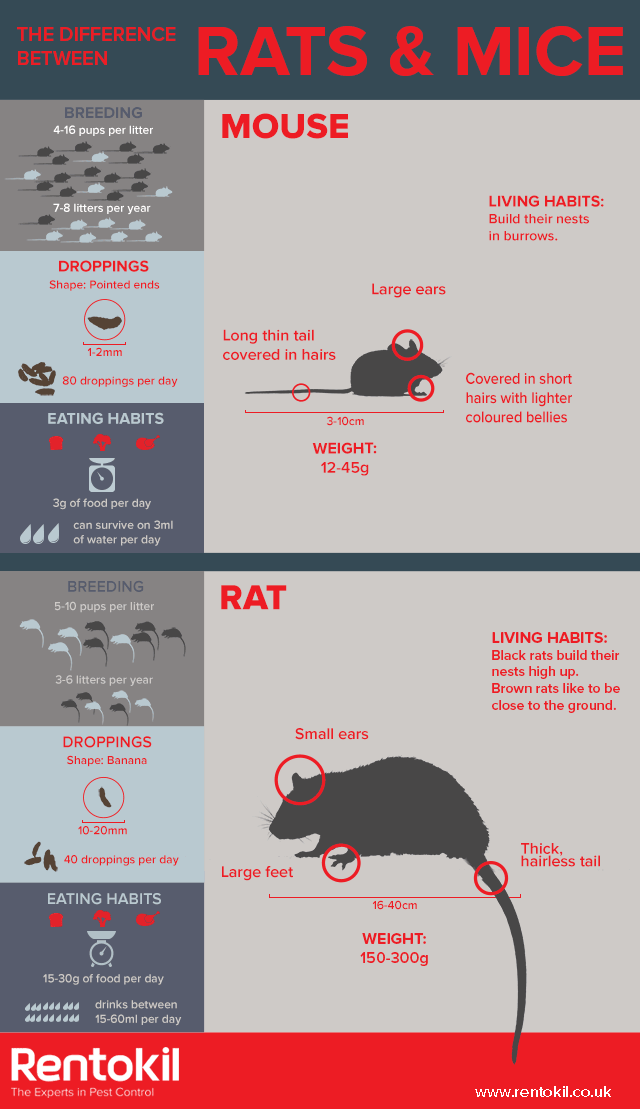
The easiest distinguishing feature of the common house mouse is its compact size, measuring 3–10 cm long (excluding the tail).
However, a mature house mouse can be confused with a young juvenile or baby rat. To tell a mouse vs young rat apart, look closely at their proportions:
- Ears: A mature mouse has noticeably larger ears relative to its head size than a young rat.
- Tail: A mouse features a longer, thinner tail compared to its body length than a rat (often longer than its head and body combined).
- Head & Feet: A young rat has a blunter muzzle alongside distinctly larger feet and head compared to its body proportions.
- Colouring: Mice are usually light grey or brown in colour, with a lighter shade or off-white tone on their bellies. A black house mouse or darker variant may also be encountered in urban areas.
What do rats look like? Rat Identification Guide
Identifying what a rat looks like is crucial if you suspect a rodent problem in your home or business. Rats are bigger and heavier than mice, have shorter tails and produce bigger droppings that they produce around 40 a day.
Brown rat (Rattus norvegicus):

Physical Differences: Brown Rat vs Black Rat
There are two primary species of rat encountered across Ireland: the brown rat (Rattus norvegicus, also known as the common or Norway rat) and the ship rat (Rattus rattus, or black house rat).
While both are larger than a house mouse or field mouse, a closer look at their physical features reveals key differences:
Brown Rat (Rattus norvegicus)
- Body & Size: Features a thicker, heavy-set body (typically growing to 20–25 cm long).
- Snout & Head: Distinctly blunt nose and a heavy jawline.
- Ears: Small, thick, hairy ears that do not easily reach the eyes when folded down.
- Tail: A thick, scaly tail shorter than the length of its head and body combined, with a noticeably paler colour underneath.
Ship Rat / Black Rat (Rattus rattus)
- Body & Size: Features a more slender, agile body built for climbing.
- Snout & Head: A distinct pointed nose and narrower face.
- Ears: Large, thin ears with virtually no hair, easily reaching past the eyes when folded.
- Tail: A thin, dark tail longer than its head and body combined.
Black rat (Rattus rattus):

How to Identify Rats vs. Mice
Telling the difference between rats and mice in your home or at your business premises is crucial for effective pest control. While often confused, especially a young rat with a mature mouse, key distinctions in appearance, rat vs mouse droppings, sounds, and habits can help you identify whether you have a mouse or rat in the house.
Physical Differences: How to Identify Rats vs. Mice
- Size & Proportion: A house mouse is much smaller (3-10 cm long) than a rat (16-40cm). A mature mouse has noticeably larger ears and a longer tail relative to its body compared to a rat. A young rat, despite its smaller size, will have disproportionately larger feet and head compared to its body than a mouse.
- Colour & Features: Mice are typically light grey or brown with lighter bellies. Brown rats have thicker bodies, small hairy ears, and blunt noses, with a tail shorter than their head and body combined. Black rats are more slender, with large thin ears, pointed noses, and a tail longer than their head and body.
Rat vs Mouse Droppings
A strong indicator of the pest you are dealing with is droppings. Rat droppings and mice droppings vary in size, shape, and distribution.
- Mouse Droppings: Small (around 3-8mm long), granular, and black, often found scattered randomly, especially near nesting areas. A single mouse produces around 80 droppings per day, scattered randomly near nesting or feeding areas.
- Brown Rat Droppings: Larger, dark brown, and typically spindle-shaped, resembling olive stones. They produce roughly 40 to 50 droppings daily in concentrated areas.
- Black Rat Droppings: Longer and thinner than brown rat droppings, often curved like a banana with pointed ends.
- Fresh vs Old Droppings: Fresh rat or mouse poop is soft, dark, and shiny. Older droppings turn dull, grey, and crumble easily when touched.
Note: Squirrel poo and rat poo can look similar in size, but squirrel droppings tend to be rounder and are mostly found in lofts or near trees.
Sounds in Your Home: Rat or Mouse?
The type of noise you hear can offer clues about your uninvited guests. Noises offer important clues when determining if you have rats or mice in the house:
- Mice: Expect light, quiet scurrying or scratching sounds as they move quickly, often heard through wall cavities, ceilings, or cupboards at night..
- Rats: Sounds are usually heavier, including more distinct scampering, gnawing, and thumping noises, particularly from brown rats which are heavier.
Rodent Damage: Mouse or Rat?
Rodents can cause real damage to your home or business premise. Mice and rats cause damage slightly differently, providing further identification clues.
- Mice: When eating cereals, mice "kibble" the grain, removing the outer husk. Their gnaw marks are smaller. They don't need to drink water often.
- Brown Rats: Prefer cereals and cut grain cleanly. They tend to seek food in the same places nightly and must drink water daily. Their burrows can cause extensive damage to sewers and foundations. Their oily fur leaves continuous smudges along paths.
- Black Rats: Prefer moist fruits and don't necessarily eat in the same spot each night, making them harder to bait and control. They are agile climbers and their activity high up in structures often leaves separate smudges from walking on their toes.
Behavioral Clues: Understanding Rat vs. Mouse Habits
Understanding their living preferences and breeding patterns helps ensure proper rat and mouse pest control.
Habitats & Smear Marks
- Brown Rats: Typically live at ground level in burrows, sewer networks, and beneath building foundations. Grease and body oils on their fur leave dark, continuous smear marks along walls and skirting boards.
- Black Rats: Agile climbers that prefer higher nesting locations such as lofts, roofs, and attic spaces (common around port areas).
- Mice: Live at ground level but climb exceptionally well. In severe infestations, accumulated body oils, dirt, and urine create distinct "grease pillars".
Breeding & Population Growth
- Mice: Mature rapidly and reproduce quickly, producing 7–8 litters per year (with 4–16 pups per litter).
- Brown Rats: Produce 3–6 litters per year (averaging 7–8 pups per litter).
- Black Rats: Produce 3–6 litters per year (averaging 5–10 pups per litter).
Contact Us
Rats or Mice: Frequently Asked Questions
-
How do I know if it's a rat or a mouse?
You can determine whether it is a rat or a mouse by examining their physical proportions, the size of their droppings, and the specific type of damage they leave behind. While both have incisor teeth and long tails, mice are significantly smaller than rats, and even a young rat can be identified by having disproportionately large feet and a head that looks too big for its body.
-
What is the difference between having mice and rats?
The primary differences are in their size (rats being far bigger), behavior and nesting habits; brown rats typically live in burrows or sewers and are wary of new objects, whereas mice are adventurous explorers that tend to live in various parts of a building and require less water than rats. Additionally, mice produce more litters per year than rats, meaning an infestation can grow more rapidly if left untreated.
-
Did I just see a mouse or a rat?
If the rodent you saw was between 3 and 10 cm long with large ears and a tail longer than its body, you likely saw a mouse. If the animal appeared much larger with a thick body, a blunt nose, and small hairy ears, it was almost certainly a brown rat.
-
Do rats come out during the day?
While rats are primarily nocturnal and prefer to be active at night, they may occasionally come out during the day if their nest has been disturbed or if there is high competition for food due to a large infestation. Seeing them in daylight often indicates that the population has grown significantly.
-
How can you tell if it's mice or rats?
You can tell the difference by looking at their droppings; mouse droppings are small and granular (3–8mm), while rat droppings are much larger, dark brown, and typically spindle-shaped like a grain of rice. You can also distinguish them by the noises they make, as rats produce heavier scampering and thumping sounds compared to the light, quiet scurrying of mice.
-
Is it better to have a mouse or rat in your house?
Neither is desirable because both carry dangerous diseases like Salmonella and E. coli, but rats are generally considered more destructive because their powerful gnawing can cause extensive damage to foundations, pipes, and electrical wiring. While mice are easier to trap because they are more curious, they reproduce much faster, which creates a different set of challenges for homeowners.
-
What is the visible difference between a rat and a mouse?
The most visible differences are that mice have pointed noses, large ears, and thin tails, while common brown rats have blunt noses, small ears, and thick bodies with tails shorter than their combined head and body length. Furthermore, black rats are more slender than brown rats and possess tails that are longer than their bodies, which helps them balance while climbing in lofts or roofs.
-
Do rats eat mice?
Yes. Rats are aggressive omnivores and will readily kill and eat mice when sharing the same territory.