

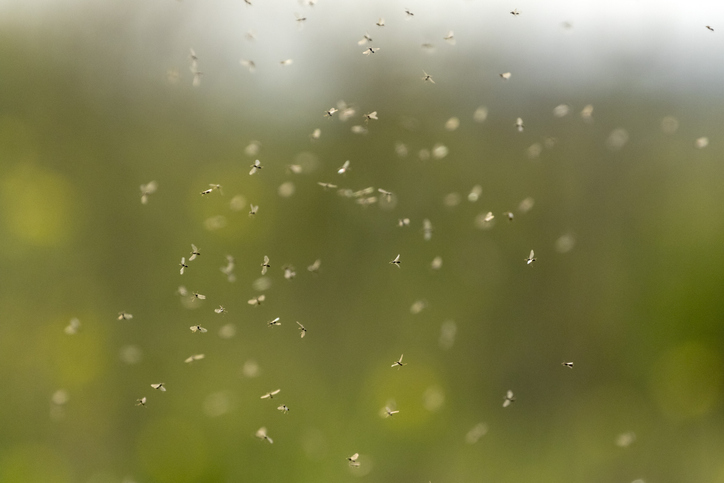
There is nothing quite as peaceful as an Irish summer afternoon until it is abruptly interrupted by the unwelcome appearance of thousands of flying insects. One moment you’re enjoying a barbecue; the next you’re retreating indoors as your patio is swarmed.
Often colloquially called ‘Flying Ant Day’, this phenomenon can feel like a sudden invasion. But here is the good news: you don’t have to surrender your garden to them for long. By understanding the biology behind these swarms, you can reclaim your space and protect your home.
In this guide, we break down the science of these winged intruders, clarify the common myths surrounding their ‘sudden’ arrival, and provide actionable steps to maintain your comfort this swarming season. This article covers:
- Where do flying ants come from?
- What exactly are flying ants?
- The science of the swarm: what-triggers-flying-ant-production
- Why do flying ants all appear at once?
- Are flying ants dangerous?
- Calendar of the reproductive cycle of an ant colony
- How to handle a flying ant invasion
Where do flying ants come from?
When thousands of winged insects suddenly appear out of nowhere, it is easy to assume they have migrated over from the UK or continental Europe, or that a strange new pest has arrived in the neighbourhood. The reality is much closer to home: these ants have been living right under your feet all year long. They are the same species of black garden ant (Lasius niger) you might spot scurrying around your garden in spring and summer. The winged individuals that emerge from the nest have, in fact, grown wings for a very special occasion.
Common ant nesting spots
The black garden ant thrives in both rural and urban environments in Ireland. Their nests are hidden in several common locations around homes:
Wall cavities and underfloor areas: If a property has underlying dampness or historical water damage, ants may occasionally establish nests indoors. They use the gaps in cavity walls, the spaces beneath suspended flooring and can chew through soft, rotting wood.
Beneath patios and paving stones: Sand and loose soil under patio slabs provide the perfect, well-insulated architecture for an ant colony. It keeps them warm and protects them from the Irish rain.
Lawns and flowerbeds: They love well-drained soil and can build extensive tunnel networks directly under manicured lawns, the edges of raised beds or at the base of garden walls.

What exactly are flying ants?
To understand the swarming phenomenon, it helps to understand the life cycle of ants and the roles of the different ants within the colony.
The life cycle of the black garden ant
The black garden ant (Lasius niger) undergoes “complete metamorphosis”, transitioning through four stages:
- The egg: A queen lays her first batch of tiny, white eggs, sustaining herself entirely on her own fat reserves and dissolved wing muscles during this time.
- The larva: Within a few weeks, the eggs hatch into legless, white larvae. They rely on the queen for a liquid diet until mature worker ants take over the task.
- The pupa: Once a larva is fully grown, it spins a protective silk cocoon and enters the pupal stage to develop all the adult ant organs.
- The adult: An adult ant emerges from a cocoon. This whole life cycle typically takes 6 to 8 weeks, depending on the temperature.
The ant castes
An adult ant’s role in the colony depends on its caste:
- Workers: Sterile females live for 1 to 2 years, spending their lives foraging, cleaning and defending the nest.
- Queen: A successful Lasius niger queen can live for 12 to 15 years, laying thousands of eggs every year to keep the colony thriving.
- Future queens (female alates): These are the noticeably larger, winged ants produced only during swarming season. Their purpose is to take flight (the nuptial flight), find a mate and establish a new colony away from the main nest.
- Drones (male alates): Smaller winged ants produced only during the swarming season. Their sole objective is to mate with a queen; they die shortly after completing this mating flight.
The science of the swarm: what triggers flying ant production?
The appearance of winged ants isn’t a random decision; it’s a sophisticated, pre-programmed evolutionary strategy. While the exact trigger can be complex, research suggests that a colony only commits to producing alates when several critical conditions align.
1. Colony maturity
A fledgling colony cannot afford the luxury of alates. Because winged ants require immense energy to develop and contribute nothing to daily nest maintenance, a Lasius niger colony typically needs to be several years old. It must have established a massive workforce to gather the surplus of high-protein food required to “invest” in reproductive royalty.
2. The pheromone threshold
Within the nest, the queen acts as the colony’s central regulator. She secretes a “suppressive pheromone” that signals workers to prioritise standard female workers. As a colony expands, this chemical signal becomes diluted across the larger population. Once the signal drops below a specific threshold, the workers receive a biological “green light” to begin modifying larvae development. The queen’s high-protein summer diet, supplied relentlessly by the workers, may also play a role in changing pheromone production.
3. The royal menu
The queen doesn’t produce “queen eggs”. The difference between a standard worker (sterile female) and a future queen is purely nutritional. When environmental cues, such as lengthening days and warming temperatures, align with a surplus of high-protein resources, workers selectively feed specific female larvae a high-protein diet. This triggers developmental switches, causing these larvae to grow larger and become fertile, so they are capable of creating a new colony (they need to last a winter, then produce eggs and feed the first larvae next spring), and develop the wings needed for their future nuptial flight.
4. The production of males
The queen’s nutritional intake also plays a vital role in the creation of male drones. When the queen is fed a high-protein summer diet, it appears to induce hormonal or behavioural changes. She begins laying unfertilised eggs, which will develop into winged male drones. They don’t need the same sustained high-protein feeding that the queens need to grow and develop. They only need enough strength and energy to make a single mating flight.
Why do flying ants all appear at once?
The answer is a mix of meteorology and evolutionary survival tactics.
Meteorological requirements
The alates need specific conditions to take off and survive long enough outside of the nest.
- Warm temperature: Ants rarely take flight unless the temperature is consistently warm enough, usually above 13°C to 15°C.
- High humidity: Ants prefer humid conditions, which is why swarms almost always occur right after a summer rain shower. This moisture also softens the Irish soil, making it easier for a newly mated queen to dig her new nest later that evening.
- Calm winds: Alates are not strong fliers and need calm conditions to take off, to avoid being blown into obstacles.
The evolutionary advantages of mass swarming
Mass swarming is a sophisticated evolutionary strategy that allows Lasius niger to overcome critical survival hurdles. By launching millions of alates simultaneously, the species ensures long-term viability through three biological mechanisms:
- Genetic diversity (outcrossing): To prevent inbreeding depression, which leads to weaker colonies, ants synchronise their departure using precise regional weather cues. This “regional clock” ensures that many unrelated nests release their alates into a single genetic mixing bowl, guaranteeing maximum diversity for the next generation.
- Elite selection: The nuptial flight serves as a physical filter. Only the most resilient and athletic males can successfully pursue a queen mid-air. This helps ensure that the strongest genes are passed on to the future worker army, giving the new colony a competitive edge.
- Strategic colony expansion: When airborne, the winged queens can mix with ants from distant nests by using wind currents to travel farther from their birth nest. This dispersal prevents competition with local colonies for resources and allows the species to claim new territory across the landscape.
Are flying ants dangerous?
The short answer is no, flying ants are not dangerous. They do not transmit diseases, they do not sting, and they have absolutely no interest in attacking humans.
While they are entirely harmless from a health perspective, they can be a major nuisance. Having a cloud of insects interrupt your evening or finding dozens of them crawling on your kitchen counter is frustrating, but rest assured, it is a temporary inconvenience rather than a safety hazard.
The indoor exception
While they want to mate outdoors, flying ants are notoriously clumsy pilots. They will easily drift through open windows, patio doors, and conservatory vents.
If they do end up inside your home, it is by accident, as they usually cannot survive very long indoors without moisture or the soil they need to establish a new nest. However, if you see them emerging from under your skirting boards or floorboards, it means an ant colony was already established in your house before they grew their wings, and you may need help removing it.
Calendar of the reproductive cycle of an ant colony
Here is a seasonal calendar for a mature Lasius niger colony that summarises how resource levels and environmental factors affect the queen, workers and alate (wing) production throughout the year.
|
❄️ Winter (November – February): Hibernation |
|
|
🌱 Spring (March – April): Awakening & inception |
|
|
☀️ Early Summer (May – June): The main trigger peak |
|
|
🌤️ Mid-summer (July): Maturation and pupation |
|
|
🍂 Late summer/ autumn (August – October): The launch and wind down |
|
How to handle a flying ant invasion
If the ants have decided to launch their mating festival right on your doorstep, here is a practical, expert-approved battle plan to manage the swarm.
- Block entry: At the first sign of a swarm, close all windows and doors, especially conservatory vents and patio doors.
- Deploy the vacuum cleaner: The quickest way to clear an indoor swarm is to vacuum the ants out of the air and off surfaces.
- Seal the nesting sites: Look around your property for potential nesting sites. Use mortar or exterior sealant to seal small cracks and gaps in patios, paving slabs, and your home’s foundation. The harder it is for a newly mated queen to find a crevice to dig into, the less likely she is to set up a colony right next to your house.
- At night, turn off unnecessary lights and draw curtains: Winged ants use the light of the moon, stars or the setting sun to orient themselves and keep a straight flight path. Strong artificial light sources, such as streetlights, porch lights or bright television screens, attract them.
For more details on controlling ants, see our blog on how to get rid of ants.
When to call the professionals
In most cases, a flying ant swarm is a self-limiting problem that resolves itself within 24 to 48 hours after the nuptial flight ends. However, there is one major red flag you should be aware of.
If you see flying ants suddenly emerging from inside your property, such as from beneath skirting boards, out of wall cavities or from under floorboards, you are not dealing with accidental travellers from the garden.
This is a clear indicator of a well-established, mature indoor nest. Because these nests are buried deep within the structure of your home, DIY sprays and traps rarely reach the queen. If you trace the source of the flying ants back to the interior of your home, it’s time to call in the professionals at Rentokil to locate and safely eradicate the root of the problem.
FAQs
Are flying ants dangerous?
No, flying ants are not dangerous. They do not transmit diseases, they do not sting, and they have no interest in attacking humans. While they are a major nuisance, they are not a safety hazard.
Why do flying ants all appear at the same time?
Flying ants emerge in mass swarms when specific weather conditions — warm temperatures (above 13°C–15°C), high humidity and calm winds — align. This “synchronised emergence” is an evolutionary strategy to prevent colony inbreeding by mixing with other colonies, and for “predator satiation”, which increases the chances of forming new colonies.
Does “Flying Ant Day” really happen on just one day?
No, despite the name, it is not a single day. It is a period of swarming activity that typically spans several weeks during the summer months, usually peaking between July and August, depending on the weather.
Why are there flying ants inside my house?
Flying ants are notoriously clumsy pilots and often drift inside through open windows, patio doors or vents by accident. However, if you see them emerging from inside your walls, skirting boards or floorboards, it indicates an established ant colony within your home structure.
When should I contact a professional pest control company?
In most cases, flying ant swarms are self-limiting and resolve within 48 hours. You should call a professional if you trace the source of the ants back to an interior nesting site, such as beneath your floorboards or inside wall cavities, as these nests are difficult to treat with DIY methods.