
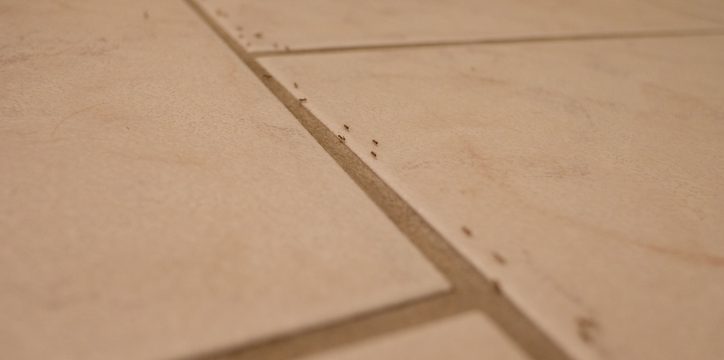

Finding ants in the house can be incredibly frustrating, particularly during the warmer months when the ant population seems to explode, their soil excavations appear around the garden, and they are constantly on the hunt for sources of food.
The problem with ants is how rapidly they can escalate. It generally starts with just one or two lone “scout” ants wandering around your floors or kitchen counter. However, if those scouts hit the jackpot, discovering a few sugar crystals, a drop of spilt juice or some bread crumbs, the situation can change very quickly. They will rush back to their nestmates to tell them, turning a couple of stray ants into a full-scale, marching infestation in a few hours.
The good news is that you don’t have to share your living space with them. In this complete guide, we will break down what you need to know to take back control of your home. We’ll help you identify which type of ant is invading your kitchen (usually not difficult in Ireland), provide five practical steps to eliminate them safely, and outline when a minor nuisance requires professional intervention.
What types of ants invade Irish homes?
Ireland has very few native ant species because of its history of geographic isolation during and after the last Ice Age. According to the National Biodiversity Data Centre’s Ants of Ireland dataset, 23 species have been recorded in the country, including introductions from other countries.
From Rentokil’s experience in treating ant infestations in Irish homes, however, the vast majority of infestations are caused by one species, the small black ant (also called the black garden ant), Lasius niger.
- Appearance: Small, glossy, and ranging from dark brown to jet black. Workers are typically 3-5mm long, while the queen can reach up to 9mm. They do not possess a stinger.
- Behaviour and habits: While they naturally nest outdoors, frequently under patio paving slabs, in driveways, or beneath sunny garden walls, they are relentless foragers. During mid-to-late summer (usually July and August), this is also the species responsible for Ireland’s infamous “Flying Ant Day”, when winged males and new queens take flight to mate.
- The diet: The workers seek sugary foods and carbohydrates, such as drops of jam or honey and even breakfast cereal in boxes. They will also forage for protein-rich food, which the queen needs to lay eggs, and the larvae need to grow and develop.
Why do ants go inside your home?
Ants don’t just wander into your home by accident; they are highly organised, purpose-driven insects. If you see a line of them marching across your kitchen counter, it’s because your home is providing something they want, and you let them in.
Understanding what draws them indoors and how they manage to enter your home is the secret to keeping them out for good.
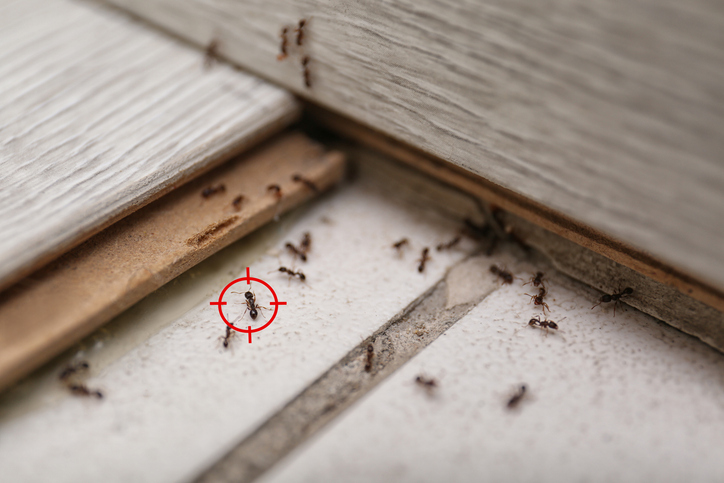
The foraging mission for food and water
The primary reason ants enter Irish homes is to obtain resources to sustain their rapidly growing colony.
- The search for sugar and protein: Ants are opportunistic feeders. They are highly attracted to carbohydrates and proteins, and because they are tiny, they only need tiny amounts to be drawn to them. Food crumbs, sticky drops on the floor or counter top, unrinsed tins, and food in kitchen bins are the equivalent of an all-you-can-eat buffet to a scouting ant.
- The need for moisture: Just like us, ants need water to survive. During dry spells, or if an outdoor water source dries up, worker ants will venture into kitchens, utility rooms and bathrooms seeking moisture, which could be from water drops around the sink, dripping taps or condensation.
How ants make “chemtrails” to mark a food source
An ant infestation usually starts with a single scout. When a foraging scout ant finds a reliable food or water source in your home, it doesn’t just eat and leave. It takes food back to the nest, depositing an attractant chemical, called a pheromone, to mark its route. The chemical secreted by Lasius niger has been identified by chemists as a simple organic molecule (they call it 3,4-dihydro-8-hydroxy-3,5,7-trimethylisocoumarin, but you don’t need to remember that!). This is secreted from the ant’s hind gut as microscopic droplets that are placed on the ground while it walks along the route.
When the forager returns to the nest, it attracts the attention of other ants, alerting them to follow the trail to the food. These new foragers reinforce the trail by depositing pheromone as they travel in both directions, depositing more near the food source.
The pheromone chemical has low volatility and is fairly stable, but because it is deposited in microscopically small amounts, each tiny drop evaporates in about an hour. So the trail only persists while it is actively reinforced by successful foragers. Once a food source is exhausted, the foragers return to the nest without food and stop applying the pheromone; then the trail fades away.
Ants can remember their routes
Ants are cleverer than you might think! Once they have followed a trail a few times, they can remember the route and don’t need a chemical signal. They are thought to remember routes using visual cues and can even ignore a chemical trail if the direction conflicts with their memorised route. Scientists have tested this by laying chemical trails in a different direction from a food source they have given ants. This ability allows them to gather food more efficiently, as they can walk about 25% faster when they don’t deposit pheromone or check for its scent.
The Irish weather factor
Ireland’s notoriously unpredictable climate plays a large role in indoor ant behaviour.
- Summer deluges: When heavy Irish rain saturates the soil, outdoor ant nests can become completely flooded. To save the queen and the larvae, the colony will seek immediate refuge on higher, drier ground, which frequently means moving into your wall cavities, under skirting boards, or beneath floors.
- The spring awakening: As temperatures rise in late spring, ant colonies experience a population boom. With more mouths to feed, outdoor food sources become scarce, forcing worker ants to expand their foraging range into your living space.
How do ants enter your home?
If you’ve ever watched an ant seemingly materialise out of thin air on your kitchen counter, you know they are masters of infiltration. Because of their small size, standard home defences often aren’t enough. They don’t need an open back door to get inside; a gap the thickness of a credit card is a massive gateway.
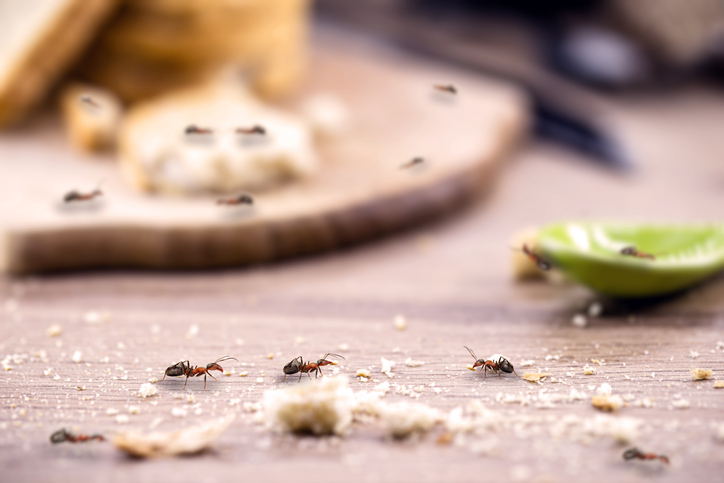
Here are the most common entry points ants use to invade Irish properties:
- Structural cracks and fissures: Over time, homes settle, creating hairline cracks in foundation walls, brickwork, mortar, or concrete slabs. Ants exploit these tiny structural flaws to gain entry from beneath the house.
- Gaps around windows and doors: Worn weatherstripping, degraded silicone sealant around frames, or gaps under exterior door thresholds are prime entry points. If light can get through a gap under your door, an entire colony of ants can too.
- Utility and pipe penetrations: Where plumbing pipes, electrical conduits, outdoor taps, or internet cables puncture your exterior walls, there are often small gaps around them. Ants can use these utility lines as a highway system straight into your house.
- Weep holes and air bricks: Necessary for ventilation in cavity walls, they become open invitations for pests if left unprotected. While essential for healthy airflow, they require a specialised mesh to keep insects out.
- Vegetation bridges: Tree branches, thick ivy, or overgrown garden shrubs that touch the exterior walls or roofline of your home act as natural bridges. Foraging ants will climb the plant, and if they can walk directly onto your home, they will eventually find food or water and inform the rest of the colony where to go.
5 Steps to get rid of ants
If you have spotted a few scout ants or a full-blown marching line in your kitchen, you can often resolve minor infestations using safe, natural methods, without needing insecticide.
Here is how to get rid of ants in your home in 5 steps:
1. Erase the invisible scent trail
Squashing the ants you can see is a very short-term fix; there will be thousands more that can replace them by following the invisible pheromone trail mentioned earlier. It may actually release an alarm pheromone from a head gland. In other species, scientists have observed nearby workers rush to the source of the chemical (their crushed colleague) with open mandibles and raised abdomens, ready for a fight. To stop the influx, you must first destroy this chemical path.
- What to do: Patiently observe where the ants are walking to identify their trail, including the entry point. Mix one part white vinegar with one part water, or use a washing-up liquid solution, and spray it directly onto the areas where you see ants marching. Wipe the surface thoroughly with the solution. The strong scent overpowers the chemical signals on the pheromone trail, and wiping will at least partly remove it, leaving the ants disoriented. When you find the entry point, spray and wipe the outside surfaces around it to prevent other ants from finding it.
2. Eliminate food and water sources
Ants enter your home in search of food and water. If you remove their access to these, they will abandon your house to forage elsewhere.
- What to do: Store all open pantry goods, especially sugar, cereal and biscuits, in airtight plastic or glass containers. Never leave dirty dishes in the sink overnight, wipe down sticky countertops immediately, and lift your pet’s food bowls when they are finished eating.
3. Block all entry points
Once you have disrupted the ant trails, you need to physically block the entry points to prevent the ants from returning inside. Don’t forget that experienced foragers can remember the way to a food source even if you have sprayed and wiped a trail (a reason not to let them escape).
- What to do: Inspect the rooms where ants are present to identify their exact entry points. Use silicone sealant to fill in cracks along skirting boards, window frames and exterior brickwork. For gaps under doors, install tight-fitting draft excluders. If ants are entering through wall vents or air bricks, cover them with fine insect mesh to maintain ventilation while blocking pests.
4. Deploy natural deterrents
Ants have a highly sensitive olfactory system, using specialised chemical detection cells (chemoreceptors) in tiny hairs on their antennae. Strong-smelling herbs and oils will overpower the pheromone scent and serve as effective, non-toxic barriers.
- What to do: Apply strong-smelling products around trails and possible entry points, such as peppermint oil mixed with water, crushed mint, lavender or thyme leaves, ground spices or used coffee grounds, and directly into cracks and holes if you haven’t filled them in yet.
5. Use ‘DIY’ ant baits
If you have a persistent ant problem in your home, you need to take more drastic action. There is a widespread urban myth that a home-made bait made with baking soda and icing sugar can destroy a nest, but there is little evidence that it can do more than eliminate a few ants.
- What to do: Buy an ant bait station for use in the home. Bait stations contain a specially formulated insecticide gel that ants carry back to the nest to feed the queen and other workers, destroying them from within. The bait will work best with no other food available to attract the ants. Follow the instructions for placing it safely:
- Place out of the reach of children, pets and wildlife.
- Do not place bait directly on counters where food is prepared.
- Place it away from the sink or where it might get wet and contaminate a sink, drain or pet bowl.
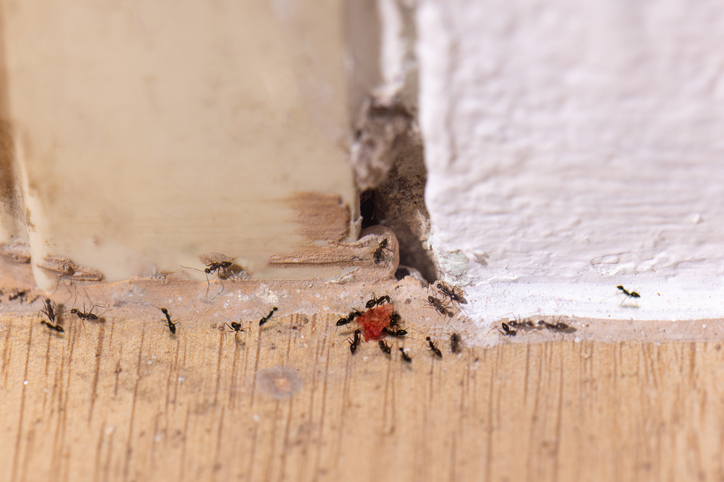
When to call professional pest control
If you are dealing with a persistent, deeply entrenched ant population, trying to fight it yourself can lead to weeks of frustration while the colony continues to grow in your garden and pester you in your home.
Call in the experts if you experience any of the following:
- The problem returns week after week: If ants disappear for a few days after you’ve tried DIY methods, but quickly return in equal or greater numbers, you haven’t killed the colony, you’ve just temporarily diverted them.
- The nest is inaccessible: If the ants are emerging from underneath concrete foundations, internal cavity walls, or structural woodwork, household solutions may not reach the source of the problem.
The Rentokil solution: how the professionals do it
Pest control isn’t just about eliminating the insects you can see; it’s about eradicating the colony at its source so they don’t come back. Here is what a professional technician does differently:
- Accurate species identification: It will almost certainly be the small black ant, but we will determine exactly which species has invaded your home so we can apply the precise treatment strategy required for that specific insect’s biology.
- Locating the hidden nest: Our technicians are trained to track foraging lines back to the source, finding hidden nests in wall voids, subfloors and gardens that homeowners routinely miss.
- Targeted, pet-safe treatments: Instead of spraying harsh, messy chemicals around your living areas, we use professional-grade ant gels and baits. These are more effective than home products, but are specifically designed to be deployed safely in homes with children and pets.
- The “domino effect”: The advanced baits we use are designed not to kill the ant instantly. Instead, the worker safely carries the bait back to the heart of the nest, sharing it with the larvae and the queen. Once the queen is eliminated, the entire colony collapses.
FAQs
What type of ants are most common in Irish homes?
The vast majority of home ant infestations in Ireland are caused by the small black ant (Lasius niger). They are small, glossy, dark brown to black in colour, and range from 3–5mm in length.
Why do ants invade houses in Ireland?
Ants enter homes primarily to forage for food (sugar, proteins and carbohydrates) and water. Additionally, during heavy rain, they may move inside to escape flooded outdoor nests, or during spring, they rapidly expand their foraging range as colony populations grow.
How do ants mark their trails?
When an ant finds a food source, it returns to the nest, depositing a pheromone “chemtrail” from its hind gut. Other ants follow this trail and reinforce it, though ants can also remember routes using visual cues and may eventually ignore chemical trails.
What are the most common ways ants get inside?
Ants often enter through structural cracks, gaps in weatherstripping around doors and windows, utility penetrations (like pipe or cable gaps), weep holes, or via “vegetation bridges” where garden plants touch the exterior of the house.
When should I contact professional pest control?
You should call the experts if your DIY methods are unsuccessful, if the ant problem returns repeatedly, or if the nest is located in an inaccessible area, such as beneath concrete foundations or inside wall cavities.


We have ant infestation in our house. Have tried ant powder and spray but cannot get rid of them. Can you give me a quote
Rentokil Initial Marketing Ie
12:15 (0 minutes ago)
to Peter.ailsby
Hi Peter,
Thank you for your enquiry.
Could you please fill out this form https://www.rentokil.ie/contact-us/ so that our local surveyor can give you a quick free quote immediately?
Thank you.
Kind regards