


Wasps, hornets and bees are often confused, but they differ in many aspects of their appearance, behaviour and ecological role. Correct identification is essential, not only to manage stinging risks and protect property, but also to safeguard valuable pollinators like bees from unnecessary pest treatment.
This guide provides a comprehensive overview of the key differences between wasps, hornets and bees, emphasising the importance of accurate identification for pest management and protection of essential pollinators. It outlines identifying features, nesting habits and seasonal behaviours for each insect, helping readers distinguish between common Irish species such as honey bees, bumblebees, European hornets and various social wasps.
By detailing the unique ecological roles and risk profiles of these insects, this guide will help you determine when professional assistance is necessary and includes:
- A quick guide to identifying wasps, hornets and bees
- How to identify a wasp
- How to identify a hornet
- How to identify a bee
- What’s the difference between the life cycles of wasps, hornets and bees?
A quick guide to identifying wasps, hornets and bees
Accurately identifying flying, stinging insects is the essential first step toward effective pest management, protecting native pollinators and mitigating risks to homes and commercial premises across Ireland.
Quick field identification checklist
- Examine the texture: If the insect is visibly fuzzy or covered in dense hair, it is a bee. Wasps and hornets possess smooth, hard, shiny exoskeletons.
- Look for the waistline: Wasps feature a thin, pinched waist connecting their thorax and abdomen. Bees have a far wider, continuous body shape.
- Observe flight behaviour: Wasps and hornets tend to hunt away from flowers, and in late summer/autumn go for sweet foods, food waste, outdoor dining areas, or rubbish bins. Bees fly purposefully between flowers.
- Note the overall size: If a yellow-and-black insect is nearly double the length of a standard worker wasp (exceeding 20mm), it is likely to be a hornet.
At-a-glance comparison table of bees, wasps and hornets in Ireland
| Visual & behavioural trait | Bees | Wasps (common & German) | Hornets |
|---|---|---|---|
| Appearance | Round, furry/hairy body; dull yellow, black, or brown; wide waist. | Sleek, smooth/hairless body; vibrant, bright yellow and black stripes; narrow waist. | Larger (18–35mm); the European hornet is brown & yellow; Asian hornets (smaller than the European) are dark brown/black with bright yellow legs. |
| Diet & feeding | Pollen and nectar from flowers. | Pest insects (caterpillars, flies) and human food waste in spring, early summer. Sugary liquids, fallen fruit, from late summer. | Live insects, tree sap, fruit, nectar. |
| Nest structure | Wax combs in tree hollows, wall cavities, or underground rodent burrows. | Grey/tan papery nests built from chewed wood pulp in attics, wall voids, sheds, or bushes. | Large, papery egg-shaped nests built high in tree canopies, barns or roof spaces. |
| Aggression level | Low; docile unless direct threats are made to the nest or individual insect. | High; aggressive defender of nest sites and active scavengers around human food. | Moderate-high; defensive within a nest radius, aggressive predator toward other insects. |
| Sting ability | Honeybees sting once (barbed stinger); bumblebees can sting repeatedly. | Smooth stinger; capable of delivering multiple painful stings in succession. | Smooth stinger; capable of multiple, deeply painful stings due to large size. |
| Primary risk profile | Conservation is a priority; professional relocation is preferred over eradication. | High operational risk for outdoor dining, food preparation zones, and public spaces. | Risk near high-traffic properties. Asian hornets are a risk to bee populations. |
How to identify a wasp
Wasps belong to the order Hymenoptera, alongside bees and ants. Ireland is home to over 120 species of stinging wasps, according to the Agriculture and Food Development Authority. Six species of social wasps build large paper nests with large numbers of workers:
- Common wasp (Vespula vulgaris): The most widespread species, nesting in attics, wall cavities and in the ground.
- German wasp (Vespula germanica): Very similar to the common wasp in behaviour and appearance, frequently nesting in buildings and roofs.
- Red wasp (Vespula rufa): A smaller, less aggressive species that builds smaller nests underground or in low vegetation.
- Tree wasp (Dolichovespula sylvestris): Builds aerial nests hanging in trees, shrubs or occasionally under roof eaves.
- Norwegian wasp (Dolichovespula norwegica): Prefers cooler, rural environments, building hanging nests in bushes and trees.
- Austrian wasp (Vespula austriaca): A specialised social parasite that invades the nests of red wasps to lay its own eggs.
In Ireland, the main species of concern are the common wasp and the German wasp, which often build nests near human activity and can disrupt domestic and commercial spaces with their aggressive behaviour.
What are the main wasp features?
The common social wasps share several key identification features:
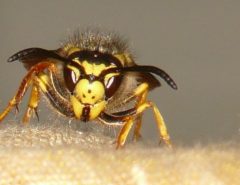
- Slender body: A narrow waist separates the thorax and abdomen.
- Yellow and black markings: Distinctive yellow-and-black banding pattern.
- Smooth body: Relatively smooth, shiny exoskeleton lacking dense hair.
- Two pairs of wings: Folded along the body when resting.
- Stinger: Females have smooth stingers, allowing repeated stings without detaching.
Visual appearance alone is not always enough to confirm species or distinguish wasps from hornets.
Where do wasps build their nests?
Social wasps build layered paper nests by mixing chewed wood fibres with saliva. Nests are typically located in:
- Underground burrows or soil cavities.
- Roof spaces, lofts and eaves.
- Wall voids and sheltered building crevices.
- Sheds, garages and outbuildings.
- Hedges, holes in trees and dense vegetation.
Nests are often hidden, but spotting frequent wasp traffic converging on a single point typically indicates a nearby nest.
Wasp feeding behaviour
Workers hunt insects and other invertebrates to nourish developing larvae and the queen from spring to summer, making them valuable components of natural ecosystems and gardens.
The workers feed mainly on sugary liquid secreted by larvae during this time, turning to fruit, nectar and other sweet foods in late summer and autumn once larval production stops. Consequently, wasp activity increases around outdoor dining, food waste bins and food preparation areas during late summer and early autumn.
How to identify a hornet
Hornets are large social wasps belonging to the genus Vespa. Hornets are generally larger and more robust than the common and German wasps. They are also important predators, feeding on a range of insects and other invertebrates. Like other social wasps, they can become defensive if their nest is threatened.
There is only one species native to Ireland, the European hornet (Vespa crabro), and a rare invasive species, the Asian hornet (Vespa velutina), that is the subject of surveillance and control because it preys on honey bees and other pollinating insects. The Asian hornet (Vespa velutina) is an Invasive Alien Species of Union Concern subject to strict national eradication protocols.
Any suspected Asian hornet sightings with photos immediately to the National Biodiversity Data Centre (NBDC) at invasives.ie.
The European hornet
The European hornet is the largest social wasp commonly encountered in Ireland. It is a naturally occurring species and should not automatically be regarded as a pest simply because of its size.
An adult European hornet is typically characterised by:
- A relatively large, robust body.
- A reddish-brown head and thorax.
- A predominantly dark abdomen with yellow markings.
- Reddish-brown colouring on parts of the legs and wings.
- A size substantially greater than that of the common wasps frequently found around food and drinks.
Despite their intimidating appearance, European hornets are not generally inclined to attack people. As with other social wasps, stinging is primarily a defensive behaviour. A hornet may become aggressive if it or its nest is disturbed.
Where do European hornets nest?
European hornets usually construct nests in sheltered cavities and locations. Potential nesting sites include:
- Hollows in trees.
- Wall cavities.
- Roof spaces.
- Chimneys.
- Sheds and outbuildings.
- Other protected spaces around buildings.
Their nests are constructed from chewed plant fibres and have a characteristic papery appearance.
A nest located well away from people may cause little or no practical problem. However, professional assessment may be appropriate where a nest is situated close to entrances, occupied buildings, public areas or other locations where people could inadvertently disturb it.
What are the differences between the European and Asian hornets?
The two species can be confused, particularly because both are relatively large wasps. However, they have several important differences.
| Feature | European hornet | Asian hornet |
|---|---|---|
| Scientific name | Vespa crabro | Vespa velutina |
| Overall appearance | Reddish-brown and yellow. | Predominantly dark/black. |
| Abdomen | Several yellow markings. | Broad orange-yellow band towards the rear. |
| Legs | Reddish-brown. | Characteristically yellow-tipped. |
| Size | Generally larger. | Generally smaller. |
| Status in Ireland | Native, established species. | Invasive non-native species of concern. |
| Ecological concern | Normal component of the ecosystem. | Potential threat to honey bees and other insects. |
How to identify a bee
Bees are insects in the order Hymenoptera, alongside wasps, hornets and ants. Ireland has count of 100 bee species: 1 honey bee (Apis mellifera), 21 bumblebee species (Bombus), and 78 solitary bee species.
Although bees can sting, they should not generally be regarded as pests. They are important pollinators and play a significant role in natural ecosystems and agriculture. Understanding the different types of bees is therefore important before deciding whether any intervention is necessary.
What are the main bee features?
Most bees have a hairier and more robust appearance than wasps. Common characteristics include:
- Hairy body: Bees generally have considerably more body hair than wasps, although the amount varies between species.
- Stockier shape: Bees often appear broader and less slender than wasps.
- Less pronounced waist: The transition between the thorax and abdomen is generally less narrow than in wasps.
- Pollen-carrying structures: Many bees have specialised areas for transporting pollen, such as pollen baskets on the hind legs or dense hairs on the underside of the body.
- Yellow, brown, black or reddish markings: Colour varies considerably between species, so colour alone is not a reliable identification method.
Not every bee is large and yellow-and-black. Some Irish solitary bees are small and predominantly dark, while bumblebees can have distinctive combinations of black, yellow, white or reddish hair.
Honey bees
The western honey bee (Apis mellifera) forms large social colonies containing thousands of workers, drones and a queen. They feed on nectar and pollen, nesting in tree hollows or in cavities in buildings.
Swarming is a natural reproductive process where the queen and a large group of workers temporarily cluster in an exposed area while scout bees search for a new nesting location. These temporary clusters generally pose no immediate threat, and local beekeepers can often safely relocate them.
Bumblebees
Bumblebees belong to the genus Bombus and are generally larger and much hairier than honey bees, with a characteristic rounded appearance. Bumblebees establish nests in a variety of locations, depending on the species. Possible sites include:
- Abandoned rodent nests.
- Compost heaps.
- Dense grassy vegetation.
- Bird nest boxes.
- Roof spaces and other cavities.
- Beneath sheds or other structures.
Bumblebee colonies are normally annual. The colony grows during spring and summer, produces new queens and males and then declines. Newly produced queens survive the winter and establish colonies the following year.
Solitary bees
Most bee species in Ireland are solitary bees, consisting of around 80 species. These include:
- Mining bees (Andrena species and others): They dig small underground burrows in bare soil, clay or sand banks.
- Mason bees (Osmia spp.): These are cavity-nesters that often use hollow plant stems, holes in wood or mortar joints. They use mud to partition and seal their nest cells.
- Plasterer and yellow-faced bees (Colletes spp.): As their name implies, they smooth or plaster the walls of their nest cells with a specialised natural secretion.
- Cuckoo mining bees (Nomada spp.): They lay eggs in the underground nests of Andrena mining bees. They often mimic wasps with red, black or yellow stripes.
- Sweat bees (Halictus and Lasioglossum spp.): Small, dark, ground-nesting bees that can resemble tiny ants with wings.
A solitary female bee typically builds or occupies her own nest. She provisions individual nest cells with pollen and nectar before laying an egg. Solitary bees can use a remarkable variety of nesting sites, including:
- Holes in soil.
- Hollow plant stems.
- Gaps in walls.
- Existing cavities.
- Dead wood.
- Purpose-built bee hotels.
Because solitary bees do not form large colonies, they are much less likely to create a conventional pest control problem. A concentration of small bees around a wall, lawn or garden does not necessarily indicate an infestation requiring treatment.
Can bees sting?
Yes, female bees can sting defensively, but male bees cannot sting as they lack the anatomy to do so. Honey bees have barbed stingers and die after stinging once, while bumblebees have smooth stingers and can sting repeatedly. Bees generally only sting when handled or when their nest is threatened.
What is the difference between the life cycle of wasps, hornets and bees?
While honey bees maintain perennial colonies that survive year-round, bumblebees, wasps, and hornets operate on an annual life cycle where the entire colony dies off each winter, leaving only newly mated queens to survive. Here is a quick comparison of these insects.
| Season | Honey bees (perennial colony) | Bumblebees (annual cycle) | Wasps (annual cycle) | Hornets (annual cycle) |
| Spring | Hive expands rapidly. Queen lays thousands of eggs; swarming occurs if overcrowding arises. | Fertilised queen emerges from soil hibernation, builds initial nest, and rears first workers. | Queen emerges from winter dormancy, builds a golf-ball-sized pulp nest, and rears first workers. | Queen emerges, constructs initial nest high up or in tree hollows, and rears first worker brood. |
| Summer | Colony hits peak size (30,000–60,000+). Maximum nectar collection and honey storage. | Colony reaches peak size (50–400 insects). Workers take over foraging while the queen lays eggs. | Colony grows exponentially (up to 10,000 workers). High demand for protein (insects/ meat) for larvae and queen. | Colony peaks (500–1,500 hornets). Heavy predation on other insects, including honey bees and wasps. |
| Autumn | Male drones are evicted to save resources. Colony shrinks and prepares winter honey stores. | New queens and drones mate. The original queen, workers, and drones die off as the weather cools. | New queens and drones mate. Larvae stop producing sugary secretion, driving workers to aggressively seek sugars outside the nest. | New queens and males mate. Old nest is permanently abandoned; workers die off with frost. |
| Winter | Colony survives together in the hive, clustering tightly around the queen for heat. | Only new, fertilised queens survive, hibernating deep underground or in leaf litter. | Nest dies completely. Only mated queens hibernate in bark, soil, wall voids, or attics. | Nest dies completely. Only fertilised new queens survive, hibernating in dark, sheltered crevices. |
Knowing the risks
Understanding the key differences between wasps, hornets, and bees is essential for assessing risks and choosing the appropriate response. While bees are valuable pollinators that should be protected and relocated whenever possible, active wasp or hornet nests near homes or commercial premises can pose significant health and safety hazards. If you encounter a high-risk nest or suspect an invasive Asian hornet sighting, seeking professional assistance ensures safe, effective and environmentally responsible pest control.
FAQs
How can I tell the difference between a wasp and a bee?
Bees have rounder, hairy bodies with wide waists and fly between flowers to gather pollen. Wasps have smooth, shiny exoskeletons, bright yellow-and-black stripes, and a thin, narrow waist.
Are hornets larger than regular wasps?
Yes, hornets are significantly larger than common worker wasps, often exceeding 20mm in length, with European hornets displaying distinct reddish-brown and yellow markings.
Do bees die after they sting?
Honey bees have barbed stingers and die after stinging once. However, bumblebees, wasps and hornets have smooth stingers and are capable of stinging repeatedly.
What should I do if I find a bee nest or swarm?
Bees are essential pollinators and should be protected whenever possible. Temporary swarms or nests can often be safely relocated by local beekeepers rather than treated as pests.
Why are wasps more aggressive in late summer and autumn?
As larval production stops in late summer, larvae no longer provide workers with sugary secretions, driving them to aggressively search outside the nest for sweet foods, often becoming a nuisance in areas where people eat outdoors and around food waste.


Leave a Reply