

The buzz of a black-and-yellow insect nearby can ruin a peaceful day, triggering immediate anxiety. But are wasps in Ireland helpful garden allies or dangerous hazards? While they serve as organic pest controllers early in the year, a wasp nest in your attic, wall cavity, or near your business quickly shifts from beneficial to hazardous.
If you are searching for effective wasp nest removal in Ireland, this guide is your essential blueprint. We explain how to identify stinging insects, the annual wasp behaviour calendar and what to do in each season, and the critical safety mistakes to avoid. Whether you are a homeowner protecting your family or a business manager safeguarding your reputation, learn how to secure your property with professional wasp control.
This guide covers:
- What’s the difference between wasps, hornets and honeybees?
- The calendar of wasp behaviour and what to do
- Wasp don’ts: 7 essential safety mistakes to avoid
- When to call a licensed professional
What’s the difference between wasps, hornets and honeybees?
Before you take any action against a black and yellow insect pest on your property, you must accurately identify exactly what you are dealing with. In Ireland, four main stinging insects often cause confusion. Here is how to tell them apart at a glance.
1. The common wasp and German wasp

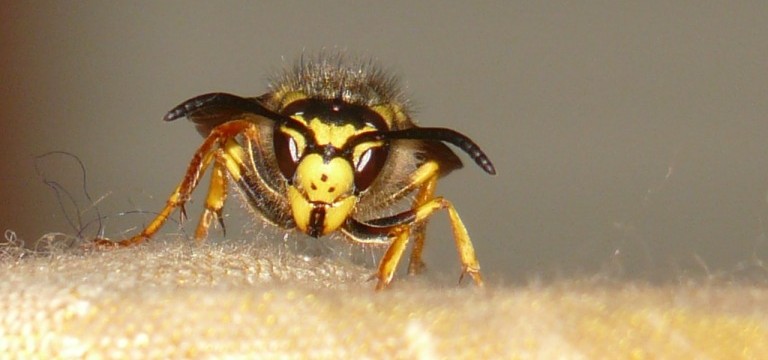
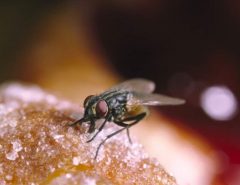
These are the species behind 99% of wasp calls in Ireland. They are smooth, practically hairless, have a distinct pinched waist and feature bright yellow and black bands along their abdomen.
- The difference: The common wasp (Vespula vulgaris) has an anchor-shaped mark on its face, while the slightly larger German Wasp (Vespula germanica) has three distinct black dots on its face.
- Risk factor: High at certain times. Both species are highly defensive of their nests and become very irritable scavengers seeking sugars by late summer.
2. The European hornet

The European hornet (Vespa crabro) is a large insect, growing up to 35mm in length, but it is exceptionally rare in Ireland.
- Key identifiers: Unlike its Asian cousin (which has made headlines in recent years), the European Hornet has a pale-yellow abdomen with dark brown stripes, a reddish-brown thorax, and entirely brown legs.
- Risk factor: Low. They are generally peaceful giants and will rarely sting unless you actively threaten their nesting site (usually located in hollow trees or deep wall voids). Unlike wasps, they will fly at twilight and are drawn to indoor lights.
3. Honeybees
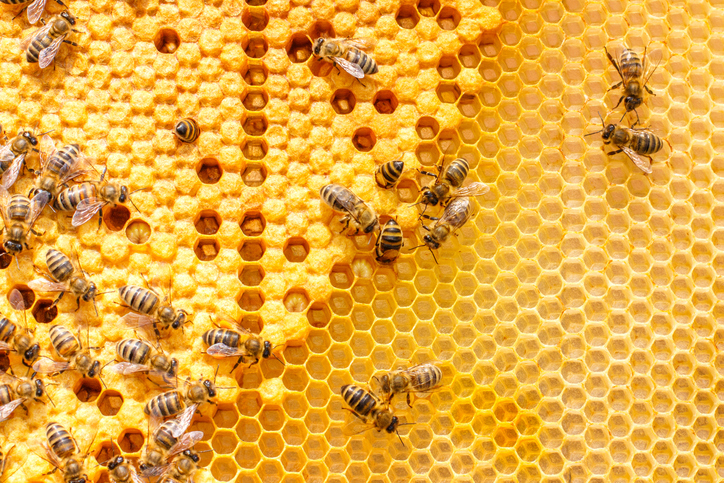
Honeybees (Apis mellifera) have a more rounded body, a thorax with short, light brown hairs and duller amber-brown and golden-yellow stripes on the abdomen. The colony survives over winter by feeding on stored honey.
- Honey bees are not treated. Bees are not aggressive by nature and will only sting as an absolute last resort if stepped on or crushed. If a honeybee swarm settles on your property, look for a local beekeeper association to safely relocate it.
4. The invasive Asian hornet
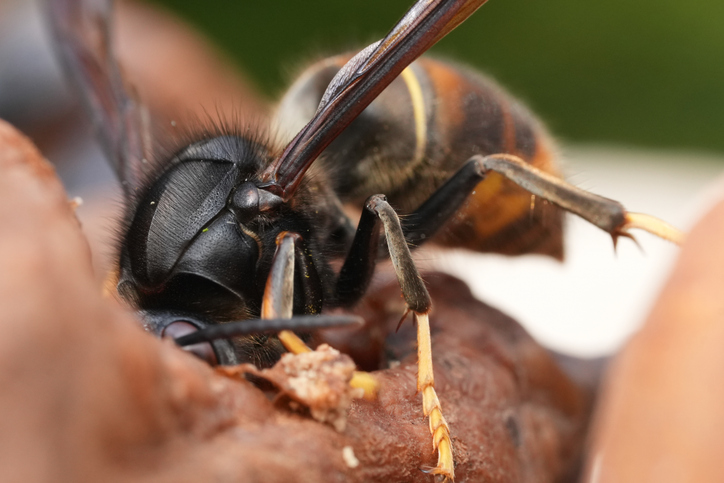
The Asian hornet (Vespa velutina) is a highly destructive, non-native invasive species that preys heavily on native honeybees and pollinators, but luckily, so far, it is very rare in Ireland.
- The 2026 Asian hornet critical biosecurity alert: Asian hornets were discovered in late 2025 in the Cork area, and in response, the Asian Hornet Management Group (AHMG), chaired by the National Parks and Wildlife Service, was established. July and August are peak months for the invasive insect, also called the yellow-legged Asian hornet.
- Key identifiers: They are slightly smaller than a native European hornet but larger than a standard wasp. Look for a velvety dark brown or black thorax, an abdomen that is mostly dark with a single prominent yellow/orange band near the tail, and distinct bright yellow tips on their legs (often called “yellow socks”). They are inactive at night.
- Risk factor: Critical. Watch out for large, dark hornets “hawking” (hovering stationary) outside honeybee hives or garden bushes. If you spot one, do not approach the nest; take a photo if you can and report it immediately via the National Biodiversity Data Centre’s Invasive Species portal.
Wasp, hornet and honeybee summary table
| Insect type | Size | Distinctive colouring | Nest type & location | Aggression level | Action required |
|---|---|---|---|---|---|
| Common / German wasp | 10–15 mm | Bright yellow and black stripes; hairless | Papery grey footballs; attics, sheds, cavity walls | High (late summer) | Call an IPCA professional if a safety risk |
| Asian hornet | 25–30 mm | Dark velvety body, yellow leg tips, orange face | Massive nests high in trees or on roof eaves | High (threat to biodiversity) | Take a photo & report it immediately |
| European hornet | 25–35 mm | Brown and yellow abdomen, reddish-brown legs | Tree cavities, quiet attics | Low (docile unless provoked) | Leave alone if away from high-traffic zones |
| Honeybee | 10 mm | Fuzzy, dull brown/gold or fat black and orange | Hollow spaces, chimneys | Very low | Protect and contact a honeybee swarm collector |
The calendar of wasp behaviour and what to do
A wasp’s behaviour changes dramatically depending on the season. Understanding this timeline allows homeowners and businesses to stay one step ahead, saving money and avoiding painful stings.
Phase 1: Winter dormancy (December – February)
The colony is dead, and the queens are hiding
- Wasp behaviour: Complete dormancy. The previous year’s colony of workers and the old queen are wiped out by the colder winter temperatures/frosts. Only newly fertilised queens survive and enter a state of diapause (hibernation). They hide away in cold, dry, undisturbed spots such as attic insulation, woodpiles and behind loose bark.
- Domestic threat level: ⚪ Zero
- Commercial threat level: ⚪ Zero
- What to do: This is the ideal time for proofing. Inspect your property’s exterior. Seal gaps in brickwork, fit mesh over air bricks, and repair damaged fascia boards. Because the spaces are empty, you can safely block entry points without trapping active insects.
Phase 2: Spring startup (March – April)
The wake-up call and scouting phase
- Wasp behaviour: As ambient temperatures consistently climb above 10°C, queen wasps emerge from hibernation. Hungry and weak, they forage for early nectar or tree sap before hunting for a nesting site. By mid-April, the queen constructs a golf-ball-sized “embryo nest” out of chewed wood pulp and lays her first batch of eggs.
- Domestic threat level: 🟡 Low (isolated stings, e.g. if accidentally touching a queen in its shelter).
- Business threat level: 🟡 Low
- What to do: Homeowners should check garages, garden sheds and attics weekly. If you spot a tiny golf-ball-sized nest with a single queen, it can easily be removed or treated rapidly by a professional before the population escalates. For businesses with outdoor seating, early spring is the time to set up queen traps to catch colony founders before they lay eggs.
Phase 3: Early summer growth (May – June)
The hidden factory
- Wasp behaviour: The first batch of sterile female worker wasps emerges and takes over foraging and nest expansion. The queen becomes a full-time egg layer, producing up to 300 eggs a day. The nest swells from tennis-ball to football size. The worker wasps are busy but generally non-aggressive; they hunt garden pests (e.g. aphids, caterpillars) to feed the larvae. The adult wasps do not eat the protein-rich foods; they only feed on sugary foods such as nectar, aphid secretions and a sugary secretion produced by the wasp larvae.
- Domestic threat level: 🟠 Medium (Defensive if you get within 2 meters of the nest entrance).
- Commercial threat level: 🟠 Medium
- What to do: Look for concentrations of flying wasps and steady flight paths entering and leaving a nest or hole, such as in the ground (they can use old rodent holes), a tree trunk, a crack in a wall or roof. Do not attempt to block this hole yourself. Call an IPCA-certified professional pest controller to treat the nest while it is still manageable and contained.
Phase 4: high summer peak (July – August)
Peak wasp season and key behavioural shift
- Wasp behaviour: The nest reaches maximum capacity, housing anywhere from 3,000 to 10,000 wasps. Around August, the queen stops laying worker eggs and starts producing new queens and fertile males. The lack of larvae results in the worker wasps losing their steady supply of sweet secretions in the nest. This results in them seeking their own sugary food outside the nest, including convenient human food, such as soft drinks, beer and waste food in bins.
- Domestic threat level: 🔴 CRITICAL
- Commercial threat level: 🔴 CRITICAL (Severe threat to pub gardens, cafes and food processing plants).
- What to do: Businesses must employ robust Integrated Pest Management (IPM). Empty external bins multiple times a day, wash down outdoor tables immediately after use, and position perimeter wasp traps 10 to 15 meters away from customer seating.
Phase 5: Autumn decline (September – October)
“Drunk” wasps and colony breakdown
- Wasp behaviour: The social structure of the nest disintegrates. New queens mate and scatter to find winter hibernation spots. The remaining worker wasps are left homeless, cold and starving. They gorge themselves on fermenting fallen garden fruit or nectar of late-season flowers, essentially becoming disoriented, sluggish and highly irritable (“drunk”).
- Domestic threat level: 🔴 High (Accidental stings increase as wasps crawl in unlikely places).
- Commercial threat level: 🟠 Medium to high
- What to do: Clear fallen fruit from gardens and orchards immediately. Wear thick gloves when gardening. If a nest is in a high-traffic area, it still requires professional treatment. However, if it’s away from people, you can let nature take its course, as it will die out completely by late autumn.
Phase 6: Late autumn collapse (November)
The final clear-out
- Wasp behaviour: The first severe Irish frosts reliably kill off any remaining sluggish workers and the old queen. The nest becomes completely inactive.
- Domestic threat level: ⚪ Zero
- Commercial threat level: ⚪ Zero
- What to do: Once you are certain there is no activity, old accessible nests can be safely removed and disposed of in the bin. Wasps never reuse an old nest, but clearing it out makes room to plug the gap and stop a new queen from selecting the same void next spring.
Summary of monthly wasp activity
| Month | Wasp status | Main food source | Risk level | Top priority action |
|---|---|---|---|---|
| Jan – Feb | Hibernating queens | None (dormant) | None | Structural proofing & sealing |
| Mar – Apr | Emergence & nest foundations | Tree sap/ nectar | Low | Check sheds/attics for embryo nests |
| May – Jun | Rapid nest building | Insects (protein) | Medium | Treat cavity/eave nests early |
| Jul – Aug | Peak nest size & worker sugar craving | Human food/ sugars | Critical | Strict bin hygiene & perimeter baiting |
| Sep – Oct | Colony breakdown / dying workers | Fermenting fruit | High | Clear fallen fruit; watch for sluggish wasps |
| Nov – Dec | Frost die-off | None | None | Safe removal of dead nests |
Wasp don’ts: 7 essential safety mistakes to avoid
Attempting to manage a wasp nest without professional expertise often transforms a minor nuisance into a dangerous emergency. To protect your family, staff, and property, ensure you avoid these high-risk mistakes.
- Don’t block ‘active’ entry holes in buildings: Sealing an active entrance in a building with foam or silicone will not suffocate the colony. Instead, trapped wasps may be able to chew through internal plasterboard to find a new exit, flooding your living or retail space. They can also follow internal gaps. Wasps will navigate through flooring, follow pipework or drop down through recessed ceiling light fixtures, vents and electrical sockets.
- Don’t block ‘active’ entry holes in the ground: Ground-nesting wasps usually take over abandoned rodent burrows or hollow spaces beneath garden slabs. Sealing a hole in the lawn with soil, a brick, or pouring in concrete introduces a different set of hazards.
- Multiple exits: Rodent burrows are rarely straight, single-entry tunnels. They form complex networks that often include multiple hidden emergency exits within a few metres. If you block the main hole, the wasps will simply redirect their traffic to a secondary exit, which might be right behind you, putting you at risk.
- Excavating loose soil: If you simply shovel dirt, gravel, or turf over the hole, it will not stop them. Wasps are master excavators. Within hours, the workers will dig their way back out through loose soil and will be in a defensive, aggressive state when they emerge.
- Don’t use fire, water, or accelerants: Torching a nest is a severe fire hazard, while water fails to penetrate the waterproof layers of an established nest. Both methods merely infuriate the colony, guaranteeing a coordinated swarm attack.
- Don’t attempt removal at height or in awkward spots: Nests in attics or under eaves carry a significant fall risk. A sudden defensive response from wasps while you are on a ladder or joist is extremely dangerous.
- Don’t approach or disturb the nest: Wasps release alarm pheromones when they perceive a threat, triggering a “call to arms” for the entire colony. Never approach without professional-grade protective gear, especially at night when using torches, as wasps will target the light source.
- Don’t ignore nests near people or businesses: Delaying treatment allows the colony to grow more defensive. For businesses, unmanaged nests pose a major liability, risking anaphylactic shock for customers and staff and potential reputational damage.
- Don’t rely on DIY aerosols for established nests: Off-the-shelf products are often insufficient for large colonies and can cause wasps to retreat deeper into wall cavities, making professional removal more difficult.
When to call a licensed professional
While DIY may seem tempting, wasp management can quickly become a high-risk emergency. Knowing when to stop is critical for your safety and the integrity of your property.
- The nest is established: Once a nest exceeds the size of a tennis ball, the population is too large to manage without professional-grade gear.
- Hidden or high locations: Nests in wall voids, underground or at height carry severe risks of swarming and falls. Experts use long-reach equipment to treat these safely from the ground.
- Allergy risks: If anyone nearby has a known sting allergy, DIY is never worth the risk of anaphylactic shock.
- Professional advantage: Licensed technicians use restricted-use residual insecticides that wipe out the entire colony, including returning foragers, which standard aerosols cannot achieve.
Call the experts
Whether you’re a homeowner or a business manager, Rentokil’s licensed technicians have the specialised equipment and expertise to eliminate wasp threats quickly and safely.
How can I tell the difference between wasps, hornets and honeybees?
The main visual difference is their colour and markings. Wasps (common and German) have smooth, hairless bodies with brilliant yellow and black bands. Honeybees are fuzzier, with duller amber-brown or golden-yellow stripes. European hornets are much larger (up to 35mm) with brown and yellow abdomens. If you spot a large dark, velvety wasp-looking insect with “yellow socks” (bright yellow leg tips), this may be an invasive Asian hornet, which has only recently been spotted in Ireland, and which you should report immediately to the National Biodiversity Data Centre.
Why shouldn’t I try to remove a wasp nest myself?
Attempting DIY removal is high-risk. Common mistakes, such as blocking ‘active’ entrance holes with foam or using fire/water, often trigger a defensive “call to arms”. Wasps may chew through internal walls to escape, flooding your living or retail space with thousands of angry, stinging insects. Additionally, you risk severe stings, falls from ladders and potential fire hazards.
When are wasps most dangerous in Ireland?
Wasps are most dangerous in late summer (July and August). During this peak period, the colony reaches maximum capacity (up to 10,000 wasps). Because the queen has stopped laying worker eggs, the workers are no longer fed by larvae and become aggressive scavengers hunting for sugary foods, which often brings them into direct conflict with humans in gardens, cafes and pub terraces.
What should I do if I suspect an Asian hornet is on my property?
Do not attempt to approach or disturb the nest. The Asian hornet is a destructive invasive species that threatens native biodiversity. If you spot one, take a photograph if you can do so safely, and report the sighting immediately via the National Biodiversity Data Centre’s Invasive Species portal.
Why is a wasp nest a liability for my business?
For businesses such as cafes, restaurants or warehouses, an unmanaged wasp nest poses a significant operational hazard. It creates a direct risk of anaphylactic shock for staff and customers, which can lead to public liability claims. Additionally, it can result in negative reviews, reputational damage, and attention from environmental health officers. Early professional intervention is the only way to effectively eliminate the threat and avoid these risks.

Leave a Reply